This section covers the essentials of pickleball: the dimensions of the court and net, the equipment you need, how to serve, the non-volley zone — known as “the kitchen” — and the requirement to let the ball bounce on the first two shots of every point. Each concept comes with scale illustrations and animations to make it easy to understand.
01
The court
A pickleball court has the same dimensions as a doubles badminton court: 13.41 × 6.10 metres. Its small size means it can be covered with short movements, which makes it easy to get started and largely explains how quickly the sport has spread.
Dimensions. The court is 13.41 m long by 6.10 m wide. The non-volley zone extends 2.13 m on each side of the net, and the remaining 4.57 m up to the baseline is the service area. A clear margin of 3 m around the court is recommended so players can move safely to reach the ball.
13,41 mIn length, the same as a doubles badminton court.
6,10 mIn width. The dimensions are identical for singles and doubles.
2,13 mNon-volley zone (NVZ) on each side of the net, popularly known as “the kitchen”. Its rules are one of the defining features of the game.
4,57 mService area, between the NVZ line and the baseline. The serve must bounce in it.
3 mRecommended safety margin around the court.
An easily adaptable facility. Pickleball can be played in sports halls, school playgrounds, multi-sport courts or tennis courts, as long as the surface is smooth, hard, level and non-slip. This versatility means schools can adopt it without any building work.
02
The net
The pickleball net is lower than a tennis net and slightly curved: it measures 91.44 cm high at the posts and 86.36 cm in the centre. This difference of just over five centimetres is not an installation fault; it is set out in the rules.
91.44 cmHeight at the ends, next to the posts (36 inches).
86.36 cmHeight in the centre (34 inches), just over five centimetres lower than at the ends, as set out in the rules.
6,71 mDistance between posts. As the court is 6.10 m wide, the net extends beyond both sidelines.
An intentional curve. Because it is lower in the centre, it is slightly easier to hit the ball over that part of the net, which draws play towards the middle of the court. For reference, a tennis net measures 1,07 m at the posts, about 16 cm more than a pickleball net. Both quick-assembly portable nets and fixed nets like those used in tennis can be used; portable nets make it possible to set up a court in a sports hall and take it down on the same day.
03
Paddle and ball
The basic equipment is a rigid paddle without strings and a perforated plastic ball. With these two items and a net, you can play. Both are drawn to scale.
The paddle
Rigid, without strings, and with maximum dimensions set by the rules.
43.18 cmMaximum length, handle included (17 inches).
19–20 cmUsual width. The rules do not set a separate maximum width; instead they limit it through the combined length and width.
60.96 cmMaximum limit for the combined length and width (24 inches). As a result, a paddle cannot be both at the maximum length and very wide: increasing one dimension requires reducing the other.
13–16 mmUsual thickness. Thinner paddles give more power and thicker ones more control.
200–240 gUsual weight. A light paddle makes for quicker movement; a heavier one adds power to the shot.
RigidMade from wood, fibreglass, carbon fibre, aramid or with a foam core. Wooden paddles are the cheapest and the most common in schools.
The ball
Made of hard, perforated plastic, with a bounce and flight clearly different from those of a tennis ball.
26 / 40Number of holes. Balls for indoor play usually have 26 larger holes, as there is no wind indoors to alter their flight; balls for outdoor play, 40 smaller ones.
22–26 gWeight, less than half that of a tennis ball.
7.3–7.5 cmDiameter. The holes slow the ball down, so most points are played close to the net rather than from the back of the court.
04
The serve
The serve is made diagonally, from behind the baseline, and the ball must bounce in the service area on the other side. Only one attempt is allowed, unlike tennis, where there is a second serve. The serve is not replayed when the ball touches the net either: if it clips the net and bounces in the correct service area, it is good and the point continues.
Always diagonal. The first serve is made from the right-hand side and the ball must bounce in the service area on the diagonally opposite side. Each time the serving team wins the point, the next serve is made from the other side, alternating throughout.
OneEach player gets a single attempt. If the serve is a fault, they lose their turn to serve.
UnderhandOn a volley serve, the ball must be struck below the waist, with an upward motion and with the paddle head below the wrist. These restrictions do not apply to the drop serve, where the ball is allowed to bounce before it is hit.
BehindFeet must stay behind the baseline until the ball is struck.
TwoIn doubles, both players of the pair serve: first one and, when they lose their turn, their partner. Then the serve passes to the opposing team.
No letIf the serve clips the net and bounces in the service area, it is good and play continues. In pickleball there is no let you get in tennis.
Loss of serve. When a team loses its turn to serve, the serve passes to the opposing team, which always starts serving from the right-hand side. Because both players of each pair serve in doubles, the score is called with three numbers instead of two: the serving team's points, the receiving team's points and which player of the pair is serving.
05
The double bounce
At the start of every point, the ball must bounce twice: once on the receiving team's side and once on the serving team's side. Until both bounces have happened, no player may volley.
01
The serve and the first bounce
The server hits from behind the baseline, diagonally. The receiving team cannot volley the ball: they must let it bounce on their side. This is the first bounce.
02
Return and second bounce
After the first bounce, the receiving team returns the ball, usually deep to gain time and move up to the net. This time it is the serving team that cannot volley it either and must let the ball bounce. This is the second bounce.
03
Third shot: volleying is allowed
Once both bounces have happened, any player may volley, as long as they are not inside the non-volley zone. Open play starts from this shot.
Serving team
Receiving team
Non-volley zone (the kitchen)
Where the ball bounces
Purpose of the rule. Without it, the serving team could rush the net straight away and smash the return. Requiring two bounces puts both teams on equal terms at the start of the point and encourages longer rallies, one of the sport's main attractions.
1The serve must bounce on the receiving team's side before it is hit.
2The return must bounce on the serving team's side before it is hit.
3From the third shot on, volleying is allowed, as long as the player is not inside the kitchen.
The most common beginner's mistake. Players coming from tennis or padel tend to rush the net right after serving, which usually costs them the point. Remember: the return has to bounce before it is hit.
06
The kitchen
The kitchen is the 2.13-metre zone next to the net, on both sides. In it volleying is not allowed, that is, hitting the ball before it bounces. You may, however, enter the zone and hit a ball inside it that has already bounced.
With both feet outside the line, a volley — a shot before the ball has bounced — is legal.With one foot inside, the volley is a fault, even if the rest of the body is outside the zone.Inside the zone, with the ball already bounced: the shot is legal. The kitchen is not a forbidden zone; what is not allowed is volleying from it.
Allowed
Entering the kitchen at any time.
Hitting a ball inside it that has already bounced.
Stepping on the line, as long as you are not volleying.
Not allowed
Volleying while any part of the body, clothing or paddle is touching the zone.
Stepping into the zone through momentum right after volleying.
Touching the line when volleying, since the line is part of the kitchen.
Origin of the name. According to the most widespread explanation, the term comes from shuffleboard, a game of North American origin in which the kitchen was the penalty zone. Spanish has adopted the literal translation, «la cocina», which players use far more often than the official name, “non-volley zone”.
07
Scoring
There are two scoring systems, so it is worth agreeing which one will be used before the match starts. In the traditional system, only the serving team scores; in the per-rally system (rally scoring), the point goes to whoever wins the rally, regardless of who is serving.
The same six rallies
Rally 1
2
3
4
5
6
Team that wins the rally
A
B
A
A
A
B
Classic (only the serving side scores)
1–0
1–0
1–0
2–0
3–0
3–0
Rally scoring
1–0
1–1
2–1
3–1
4–1
4–2
The values in grey are rallies won by the team that was not serving: in the traditional system they score no point and only cause a change of serve. For example, A wins rally 3 but does not score, because B was serving after winning the serve back in rally 2. That is why an 11-point match under the traditional system lasts considerably longer than one with rally scoring.
Classic scoring
To 11 or 15 points
In doubles, the score is called with three numbers: the serving team's points, the receiving team's points and which player of the pair is serving. For example, 1-0-2 means “one–zero, second server”.
Only the serving team scores.
If the serving team loses the rally, they lose the serve, not a point.
You must win by at least two points.
Matches can be played as a single game or best of three.
Rally scoring (rally scoring)
To 21 points
The point goes to whoever wins the rally, whether or not they are serving.
At 20 points, the game can only be closed out by the team that is serving.
Matches are shorter and their length is more predictable, which makes scheduling easier.
It is the usual system in competitions with many consecutive matches.
The three numbers of the score. A doubles match starts at 0-0-2: zero–zero, second server. In the first service turn of the match only one player serves, to offset the advantage of serving first. If the serving team wins the rally, the score becomes 1-0-2 and the same player serves again, now from the other side. If they lose it, the serve changes over: it passes to the opposing team, whose first player serves from the right-hand side and calls 0-1-1. This third number is one of the features that sets pickleball apart from other racket sports.
Length. A match usually lasts between 30 and 45 minutes. It can be played as singles or doubles with the same basic rules; the main difference is how much of the court each player has to cover.
08
Ways to play
Once you know the rules, all that remains is to choose how to play. They all share the same basic rules, except for the specific adaptations of wheelchair pickleball; the main difference between them is how much of the court each player covers.
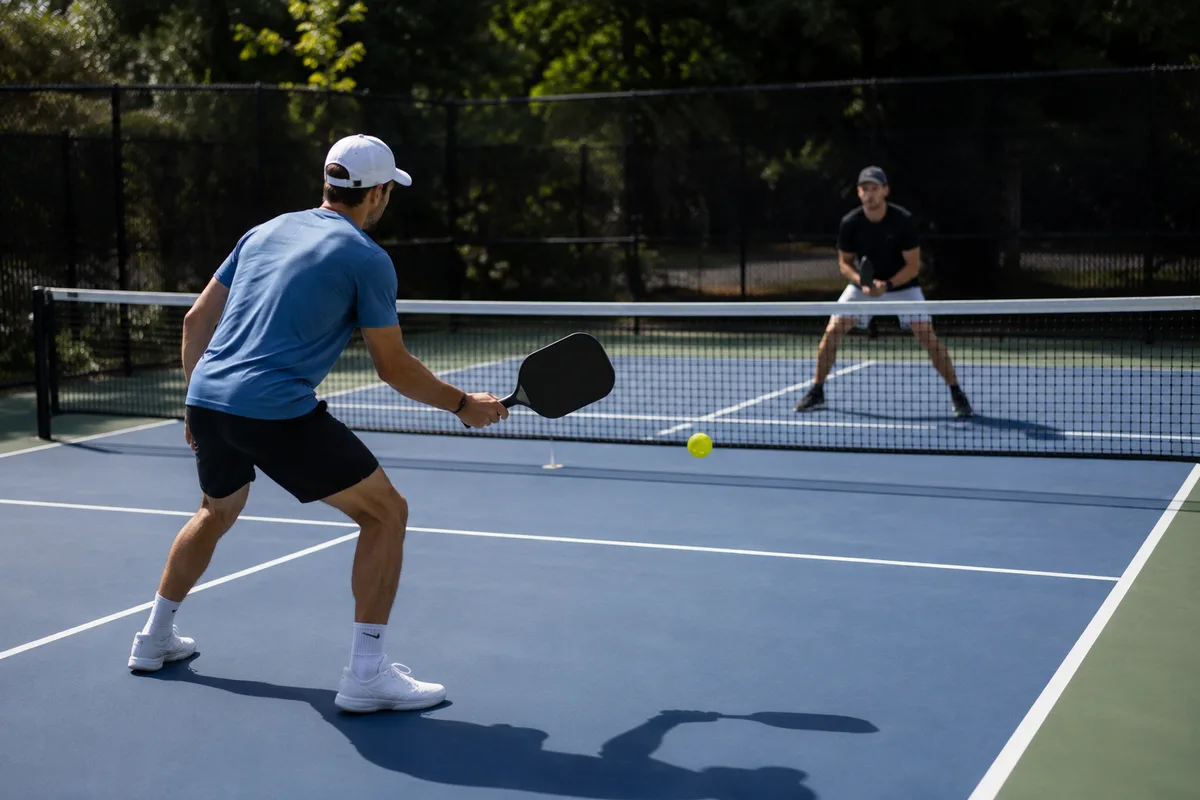
1 vs 1
Singles
The whole court is yours. Singles demands stamina, placement and tactics: every point is built shot by shot.
Matches to 11, 15 or 21 points, winning by 2
You can score only on serve, or a point per rally won (rally scoring)
The serve goes diagonally. Below the waist only if you serve out of the air: if you let the ball bounce first, that does not apply
The kitchen: a 2.13 m non-volley zone next to the net
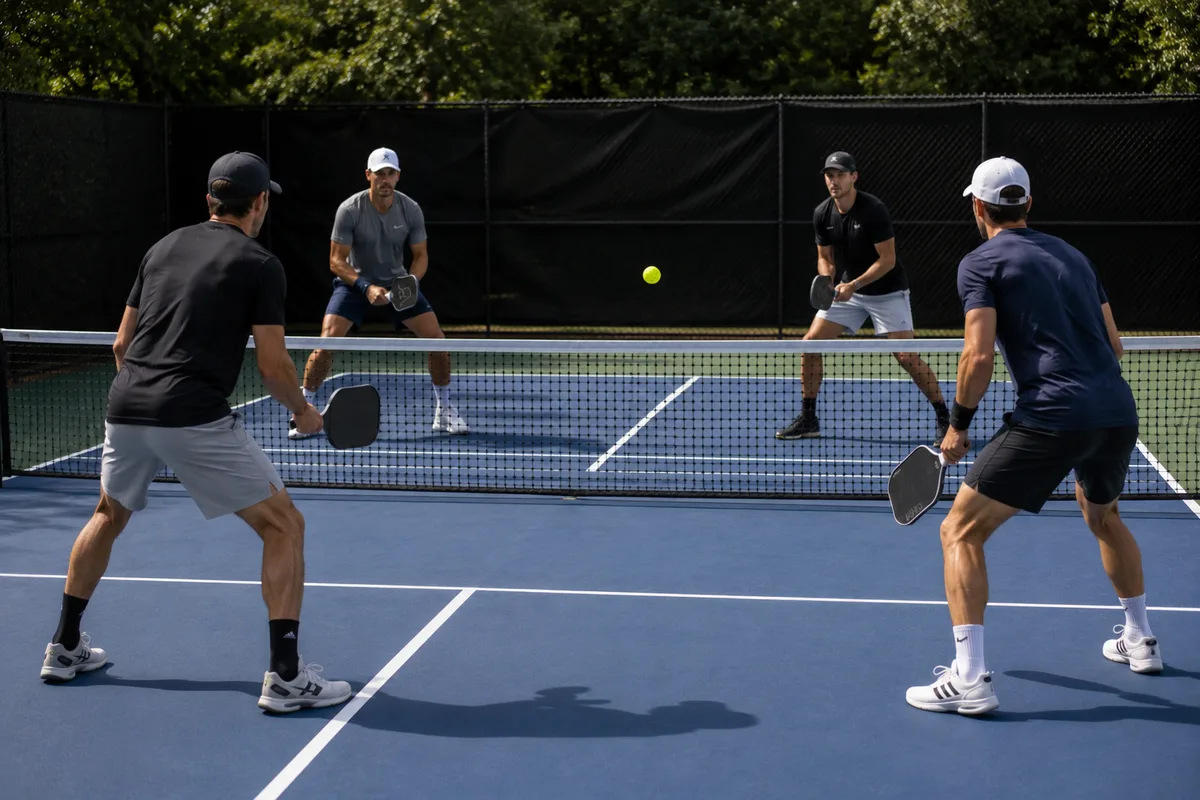
2 vs 2 The most popular format
Doubles
The most widely played format, built on strategy, communication between partners and fast exchanges at the net. It is the predominant format at most courts and tournaments in Spain.
Each team has two serves per turn.
Double-bounce rule: the serve and the return must bounce before being hit.
It can be played with traditional scoring, where only the serving side scores, or with rally scoring (rally scoring).
Height restrictions on the shot only apply to the volley serve; they are not needed on the drop serve.
Matches to 11, 15 or 21 points, won by at least two.
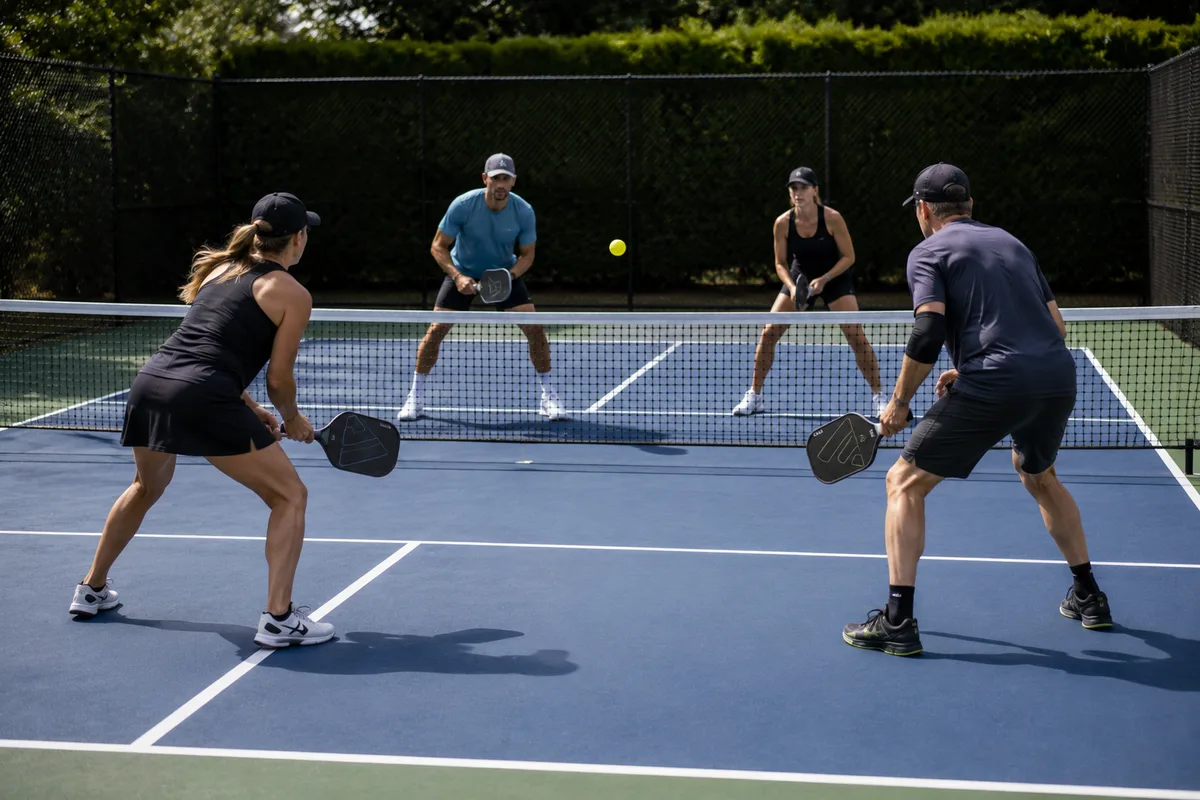
Mixed pairs
Mixed
A man and a woman on the same team, with the same rules as doubles. It is the one sport where everything really is levelled out: strength does not make the difference.
Same rules as conventional doubles
Levels from beginner to open
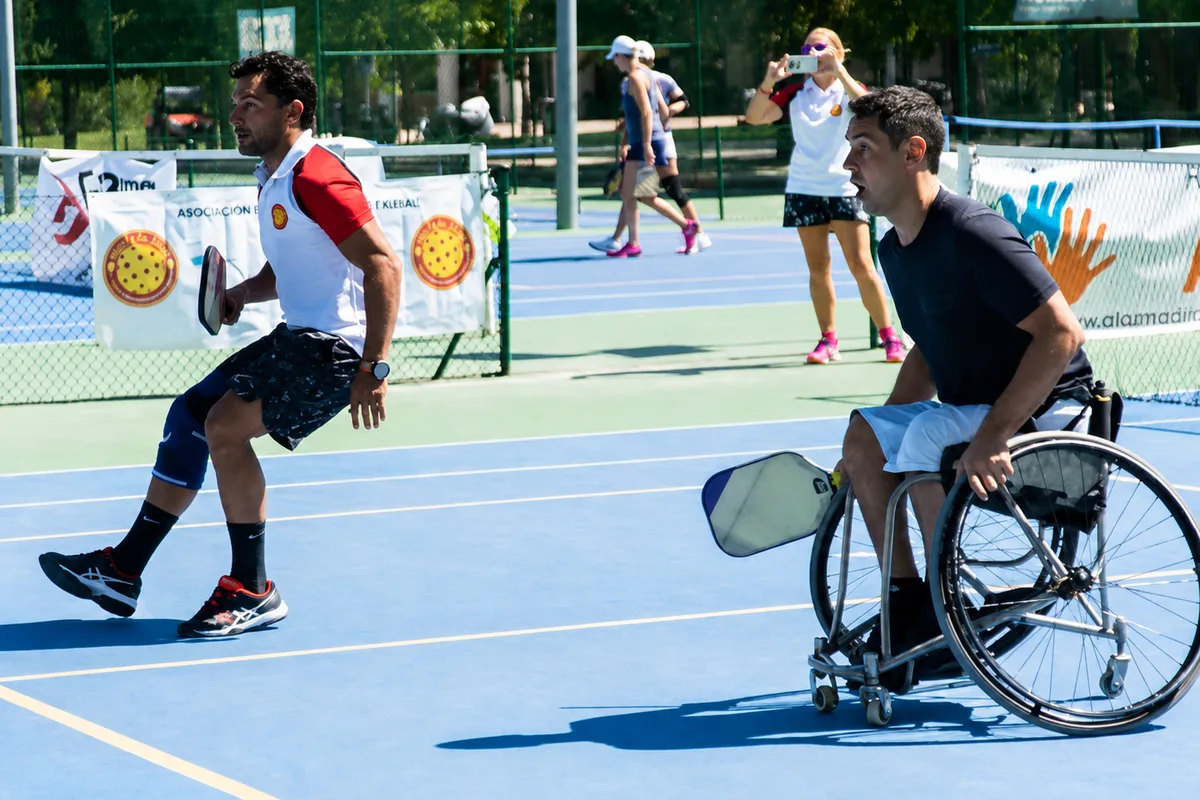
Disability inclusion
Inclusive pickleball
Adaptive pickleball removes barriers: a shared court, adjusted rules and real competition for people with disabilities.
In wheelchair play two bounces are allowed
Standard court and net, with no changes to the space
This page covers what you need to start playing. The complete official rulebook — faults, exceptions, competition and the adaptations for wheelchair pickleball — can be downloaded below.
There are over 100 verified places to play pickleball in Spain, all of them on the AEP map. And anyone who wants to take part in the Association's activities can sign up as a member for free.